
How to Find a Flat in Barcelona Without Getting Burned

Barcelona's rental market is competitive, confusing, and full of people who will take your money if you're not careful.
I've watched friends navigate this process well and watched others nearly get burned badly. One of them — an American friend who was new to the city — almost lost a significant deposit to a scammer who had a convincing story, a nice-looking listing, and just enough local detail to sound credible. She was saved by one thing: she brought a local Catalan friend with her to meet him.
More on that in a moment.
I've lived all over this city over the past ten years. The Gothic Quarter, Sarrià, Poble Sec, Sant Gervasi — different neighbourhoods, different landlords, different experiences. And every single time, I've worked through an agency. Not because it's always the cheapest option, but because in a market like Barcelona's, having a layer of accountability between you and a stranger who holds your deposit matters. More on that too.
First, here's everything you need to know about finding a flat in Barcelona without making an expensive mistake.
The Market in 2026 — What You're Actually Walking Into
Let's start with the reality check.
Rents in Barcelona have risen by 68 per cent over the past decade, reaching approximately €23.50 per square metre per month in early 2026, with premium districts such as Eixample at around €26.50/m² and Ciutat Vella at €26.30/m² commanding even higher rates.
In practical terms, a studio in mid-range neighbourhoods like Gràcia, Poble Sec, and Sant Antoni will cost around €750 to €1,100 per month. Trendy areas like Eixample, Poblenou, and El Born typically run €850 to €1,200 per month for a studio. For a furnished one-bedroom in Eixample, expect to pay €1,300 to €1,600 per month. Young professionals and expats in sought-after neighbourhoods like Sant Antoni, Vila de Gràcia, and Poblenou typically pay between €1,400 and €1,900 per month for a one-bedroom apartment.
If the listing you're looking at is significantly below these numbers, that's your first red flag.
The Neighbourhoods: Where to Look and What to Expect
I've lived in the Gothic Quarter, Sarrià, Poble Sec, and Sant Gervasi at different points, and each one taught me something different about how Barcelona works as a place to actually live rather than visit. Here's the honest breakdown across the city.
Gràcia is consistently one of the most sought-after areas — village feel, great squares, strong community energy, popular with artists and young professionals. Trendy neighbourhoods like Gràcia cost 10 to 20% more than equally convenient but less well-known areas. Worth it if it fits your budget. Vila de Gràcia specifically is the sweet spot within the district.
Poblenou is where the value has shifted most in recent years. Driven by the 22@ technology district, Sant Martí has grown around 14% year-on-year and is now within range of overtaking Gràcia in average price. If you're looking here for a deal, move quickly and expect competition.
Sant Antoni and Eixample are the most central practical options for most expats — excellent transport, everything walkable, higher prices but fewer logistical headaches.
Poble Sec and Sants are the underrated picks right now. Raval, Sants, and upper neighbourhoods are 15 to 30% cheaper than central areas with only slightly longer commutes. If you're budget-conscious, explore these seriously before committing to somewhere more expensive and obvious.
Sarrià and Sant Gervasi are beautiful, quiet, and genuinely lovely to live in — I spent time in both and they gave me a completely different experience of the city. More residential, more family-oriented, excellent if you want space and calm. Just know that you'll be further from the centre and the prices reflect the prestige of the area.
The Gothic Quarter is one of the most atmospheric places I've ever lived, and also one of the most tourist-heavy. When it's your holiday address it feels magical. When it's your daily reality it can feel relentless. Great for a short-term furnished rental while you look for something longer-term — not ideal as a permanent base on a normal budget given the current prices in Ciutat Vella.
El Born sits in a similar position — beautiful, central, and expensive for what it is. Worth knowing if your budget allows it, but not the first place I'd point someone at who's trying to get good value.
Horta-Guinardó and Nou Barris are the genuinely affordable options further out — quieter, more residential, great if you have specific community or space needs and don't mind being further from the centre.
The Scam That Nearly Caught My Friend — and How She Escaped It
This is the part of the post I most want you to read before you start your search.
My American friend was looking for a flat. She found a listing that looked great — good photos, reasonable price, nice neighbourhood, quick response from the "landlord." He described himself as a local Catalan man, knew the area well, and seemed credible. The apartment was in demand, he said. Several people were already interested. If she wanted to secure it, she'd need to pay a reservation fee to take it off the market before she could even visit.
She was close to paying. It felt real. He knew enough local detail to be convincing.
But she brought a Catalan friend with her to meet him in person. And the moment that friend started asking questions — in Catalan, with real local knowledge — the story started falling apart. He'd told our American friend he was Catalan, born and raised. In front of a local who actually knew the area, knew the language, knew the culture, he started changing his story. Got evasive. Contradicted himself about where he was from. Couldn't answer basic questions a genuine local landlord would answer without thinking. The whole thing unravelled in front of someone who could actually tell the difference.
She walked away. She didn't lose a cent.
This is one of the most well-documented rental scams in Barcelona and it follows an almost identical pattern every time. The scammer posts an ad for an attractive apartment using photos stolen from legitimate listings, often priced below market. When you make contact, the landlord responds quickly explaining they live abroad or cannot show the apartment personally. They offer to send keys by courier if you make a transfer of one to two months deposit, and pressure you with phrases like "there are five other people interested" or "if you pay today it's yours." Locabarcelona
A man was arrested in Barcelona after carrying out around fifty of these scams. His method never changed: fraudulent ads for apartments that didn't exist or weren't available, claiming he wasn't in the country to avoid showing the property, and pressuring victims with high demand urgency to formalize reservations through advance payments. SpainEasy
The reservation fee — sometimes called a señal or reserva — is not inherently illegitimate. But in the hands of a scammer, it's the mechanism that makes the whole thing work. They collect it before you've seen anything, before you've signed anything, and then they're gone.
The rules that would have protected my friend, and will protect you: never pay anything before you have physically visited the property in person. Never pay to hold an apartment you haven't seen. If someone claims they can't show it personally and offers to send keys by post, end the conversation. If the price seems too good for the area, it almost certainly is. And if you can, bring a local when you go to meet a landlord — not because all landlords are scammers, but because someone with genuine local knowledge will spot inconsistencies that you can't yet.
The Scam Formats to Know
The ghost listing. Fraudsters create fake listings by copying photos and details from legitimate properties and advertising them at suspiciously low prices. The landlord claims to be abroad and asks for a deposit before the viewing. The property either doesn't exist or belongs to someone else entirely. ExpatHelper
The double booking. Scammers take deposits from several renters for the same legitimate property, then disappear with the money. This scam particularly targets foreign students and short-term visitors who need accommodation quickly. ExpatHelper
The identity impersonation. The scammer impersonates the legitimate owner of a real rental property, obtains photos from the original listing, creates a duplicate ad with their own contact details, and waits for responses. The property is real and rentable — they just don't own it. gestor
The hidden costs contract. A landlord who doesn't disclose community fees, cleaning costs, or utility arrangements upfront. Not always malicious, but worth knowing about. Ask explicitly about all costs before signing anything.
The excessive upfront payment. I once viewed a very nice apartment — the kind of place that looks impressive on paper — and the landlord asked for eight months' rent upfront. Not a deposit. Eight months. I can't say definitively why, but I have my theories, and one of them is that I wasn't a local and they were testing what they could get away with. Whether that's what was happening or not, the answer was no. In Spain, the legal maximum deposit is two months for an unfurnished property and three months for a furnished one. Anything beyond that is not a legal requirement and you are within your rights to refuse it. If someone insists, walk away.
Why I've Always Used an Agency
Every flat I've rented in this city has been through an agency, and I'd recommend the same approach to anyone arriving here without local contacts or an established rental history in Spain.
Yes, agencies cost money. The fee is typically half a month to a full month's rent, and since the 2023 Housing Law you are not legally required to pay agency fees for long-term residential leases — that cost should fall to the landlord. In practice this is still inconsistently applied, so check what you're being asked to pay and why.
What you get in return is accountability. An agency has legal obligations, a physical address, and a name attached to the transaction. They have an incentive to vet listings properly. They can advocate on your behalf if something goes wrong with the contract or the deposit. And for someone new to the city without the local contacts to walk into a viewing and immediately know whether a landlord's story holds up — that layer of protection is often worth the cost.
If you do go the direct route, at minimum run every listing through Idealista to cross-reference it against the official market. Verify the landlord's identity documents in person. And do not hand over any money until you're standing inside the property with a signed contract in front of you.
Short-Term vs Long-Term Contracts — Know the Difference
This is where a lot of people get caught out without realising it's happening.
Spanish rental law under the Ley de Arrendamientos Urbanos (LAU) is strongly pro-tenant. The LAU sets out minimum rights that cannot be overridden by your contract — even if your landlord includes a clause that contradicts the LAU, that clause is legally void. Casaradar
For a long-term residential contract (contrato de vivienda habitual), you have significant protections. Contracts renew automatically each year until a five or seven-year threshold is reached as long as the tenant wishes to remain, protecting tenants from early eviction. Since January 2025, all annual rent increases must follow the IRAV index, which as of early 2026 sits at approximately 2.3%, meaning a landlord can only increase your rent by that amount annually. Agency fees for long-term residential leases cannot legally be charged to tenants. CasaradarCasaradar
The 11-month seasonal contract (contrato temporal) is a completely different situation. These contracts are technically legal when there's a genuine temporary reason — work placement, study, medical reasons — but they're frequently misused by landlords to avoid giving tenants the protections of a long-term residential lease. One of the most common causes for sanctions in Catalonia is disguising a regular housing contract as a temporary or room rental agreement. VERV ONE
If you are moving to Barcelona to live here — not temporarily — you are entitled to a long-term residential contract. Don't let a landlord pressure you into an 11-month contract for a property that is clearly your primary residence.
Your key rights as a tenant: maximum deposit of two months for unfurnished, three months for furnished. Deposit must be officially registered with the Catalan housing authority (INCASOL). Landlord must give two months' notice to end a contract. Deposit must be returned within 30 days of leaving. Rent increases capped annually at the IRAV index. Barcelona has stressed rental zone designations in most areas, meaning additional caps apply to new leases tied to a government reference index. VERV ONE
A Realistic Budget Before You Start Looking
Based on current 2026 prices, here's what to expect.
Renting a room in a shared flat runs around €600 to €800 per month depending on neighbourhood and whether it's furnished — the most financially sensible entry point if you're new to the city. A studio apartment costs €750 to €1,100 in mid-range neighbourhoods and €850 to €1,200 in more central or trendy areas. A one-bedroom apartment runs €1,100 to €1,600 depending heavily on neighbourhood and whether furnished. A two-bedroom apartment typically starts at €1,400 and goes up from there in most central areas.
On top of monthly rent, be prepared for first month's rent upfront, one to two months deposit, and potentially an agency fee if applicable. In practice this means having three to four months of rent available in cash before you've moved in. This catches people off guard more than almost anything else in the process.
The Platforms Worth Using
Idealista is the most comprehensive listing platform in Spain and the one most landlords and agencies use. Start here.
Habitaclia is strong for Catalonia specifically and often has listings that don't appear on Idealista.
Fotocasa is another solid option for cross-referencing listings.
Facebook groups — Barcelona Expats, Barcelona Housing, groups specific to your nationality — are where a lot of direct landlord listings appear, which can mean lower fees. They also require more caution for exactly the same reason.
Badi and HousingAnywhere are better for room rentals and shorter furnished stays while you look for something longer-term.
The Checklist Before You Sign Anything
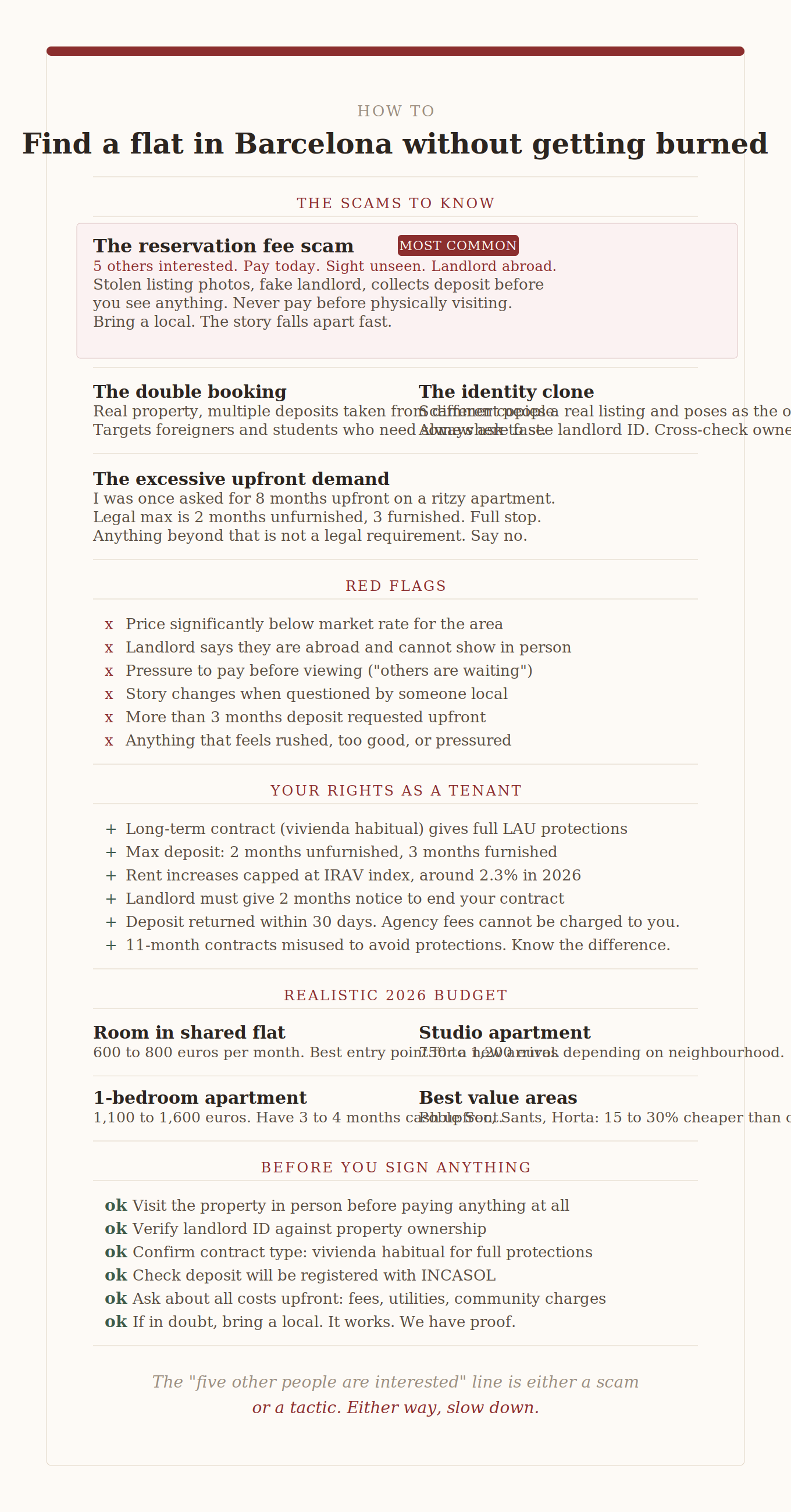
Visit the property in person before paying anything at all. Verify the landlord's identity — ask to see their DNI and check it matches the property ownership. Cross-reference the listing address on Google Street View against what you're being shown. Ask explicitly about all costs: community fees, utilities, internet, anything included or excluded. Confirm the contract type — vivienda habitual gives you full tenant protections. Check that the deposit will be officially registered with INCASOL. If anyone asks for more than three months upfront, that is not a legal requirement and you should question it. If anything feels pressured, fast, or too good, slow down. And if you have any doubt at all, bring a local.
That last one matters more than people think. My friend's story is not unusual. The thing that saved her was not legal knowledge or online research. It was having someone beside her who could expose the lie the moment the landlord opened his mouth.
One Last Thing
Barcelona's rental market is difficult right now. Supply is tight, prices are high, and the search takes longer than it should. You will probably lose a flat or two to someone who moved faster, and that's frustrating.
But don't let the pressure of a competitive market push you into moving quickly on something that doesn't feel right. The "five other people are interested" line is either a scam or a negotiating tactic. In either case it's designed to make you stop thinking clearly.
Take the time. Bring a local when you can. Read the contract before you sign it. And if you're unsure about anything in the paperwork, a lawyer who specialises in Barcelona tenant law charges around €300 to €600 for a contract review — which is significantly less than losing two months' deposit to someone whose Catalan story didn't hold up the moment a real Catalan walked into the room.