
Thinking About Busking? Read This First: What a Barcelona Street Musician Taught Me About Courage, Connection, and Actually Getting Better

Busking can look romantic from the outside.
A golden-hour park. A talented singer with a guitar. People smiling, stopping, filming, maybe even tearing up. That spontaneous magic that makes a city feel alive.
And sometimes it is exactly that.
But busking is also work. It asks a lot of a musician emotionally — visibility, unpredictability, vulnerability, and public reaction all at once. Some people stop and light up. Some ignore you. Some connect deeply. Some never look up.
That's why I didn't want this piece to be just another "how beautiful street music is" essay. I wanted it to be useful.
James doesn't dabble in this. He's done it enough to know the reality. When we spoke, he told me that at full pace he'll busk four or five days a week, three hours a day. That's not a whimsical hobby. It's a practice. A discipline. A way of life.
What Busking Actually Gives You as a Musician
One of the most interesting things James said was that he loves the immediacy of it.
Being out there takes him off his phone and puts him fully in the present. Instead of disappearing into the internet, he's connecting with real people in real time. That struck me, because so much of modern music-making can feel abstract — posting, promoting, waiting, hoping, refreshing.
Busking is the opposite.
You sing, and someone reacts. You play a song, and a stranger smiles. You perform, and the city answers back immediately.
Some of the most magical moments, James said, come from those human interactions. People stop to talk. They tell him what a song means to them. They cry. They share stories. Someone once gave him a pendant necklace. Another person told him he'd just played her late husband's favorite song.
That's the part people don't talk about enough. Busking isn't just performance practice. It's emotional contact. For musicians who've lost touch with why they started making music, that alone is worth it.
Busking Is Scary for Exactly the Reason It's Good for You
If you're scared of busking, that doesn't mean it's not for you. It may mean the opposite.
Because busking puts you face-to-face with everything musicians spend years trying to avoid:
Fear of being seen
Fear of judgment
Fear of rejection
Fear of not being good enough yet
Fear of singing your heart out while someone walks past without a glance
James didn't pretend otherwise. When I asked how he gets through the harder days — the days without connection, the ones that feel more rejecting than magical — he talked about mentality.
His point wasn't that negative thoughts disappear. It was that busking makes you aware of them. And once you're aware of them, you can start separating yourself from them.
That's an important lesson for any artist. Not every thought in your head is the truth. Not every insecure reaction deserves to run the show. Sometimes what feels like "I'm terrible" is just discomfort. And discomfort can be trained through.
James Monk's Best Busking Advice, Translated into a Guide
Based on James' experience — and what I observed watching him play — here are the biggest takeaways.
1. Start before you feel ready
The first time James ever busked, he was 15 in Manchester. He'd been to a gig with his mum, had a bit of Dutch courage, and went out with no amp, no mic — just himself and a guitar.
Musicians love to think they need the perfect setup before taking action. The perfect speaker. The perfect setlist. The perfect vocal day. The perfect confidence level. But often, the only way in is through.
Your first goal isn't to be perfect. It's to do it once.
2. Presence matters more than perfection
The biggest theme of our conversation was presence. James loves the feeling of being fully there — not split between twenty tabs in his brain, just singing, noticing, listening, connecting.
People can feel that. A busker doesn't need to be the most technically dazzling musician in the world to move people. But they do need to make people feel something. Presence, openness, and sincerity go a long way.
When you busk, don't only focus on sounding good. Focus on being present enough that people can actually feel you.
3. Talk to people
One of the loveliest things about James is how genuinely open he is. He sees the conversations that happen between songs as part of the experience, not a distraction from it.
That's important. Busking isn't a formal concert. There's a relational aspect to it — you're part performer, part host, part human magnet. People respond not just to the music, but to the atmosphere you create around it.
Busking isn't about playing at people. It's about being available for connection.
4. Use it to train your mindset
This was probably the deepest lesson in our conversation.
James described busking as a kind of mentality training. Not because it's easy, but because it surfaces your inner world so quickly. You become aware of your self-talk, your insecurities, your assumptions about what other people think, and — crucially — your ability to keep going anyway.
If you busk long enough, you won't just become a better performer. You'll become mentally stronger too.
5. Don't measure the day only by money or attention
If you're busking as part of your living, money matters. Practicality matters. But some of the real reward comes from moments you can't predict — the song that finds someone at exactly the right time, the stranger who stops because they needed to.
If the only metric is "How many people stopped?" or "How much did I make?", you'll miss the deeper value.
Stay open to the intangible side of it.
6. Let it sharpen you as a live performer
Even if busking never becomes your main thing, it can make you better. It teaches you to hold attention without perfect conditions, recover when something feels off, perform through distraction, read people quickly, and develop your stage presence in real time.
There's something clarifying about performing where nobody owes you their attention. If you can connect there, you can connect almost anywhere.
7. Encourage others the way James does
One part of the interview I loved: when I told James I was scared to sing with him, he didn't dismiss the fear. He just made it feel possible.
He said encouraging other people to try is one of the things he loves most about busking. That generosity matters. It made the whole experience feel bigger than one performance — a reminder that music can live in the invitation, not just the polished release.
If you're already comfortable busking, be the person who makes it easier for someone else to try.
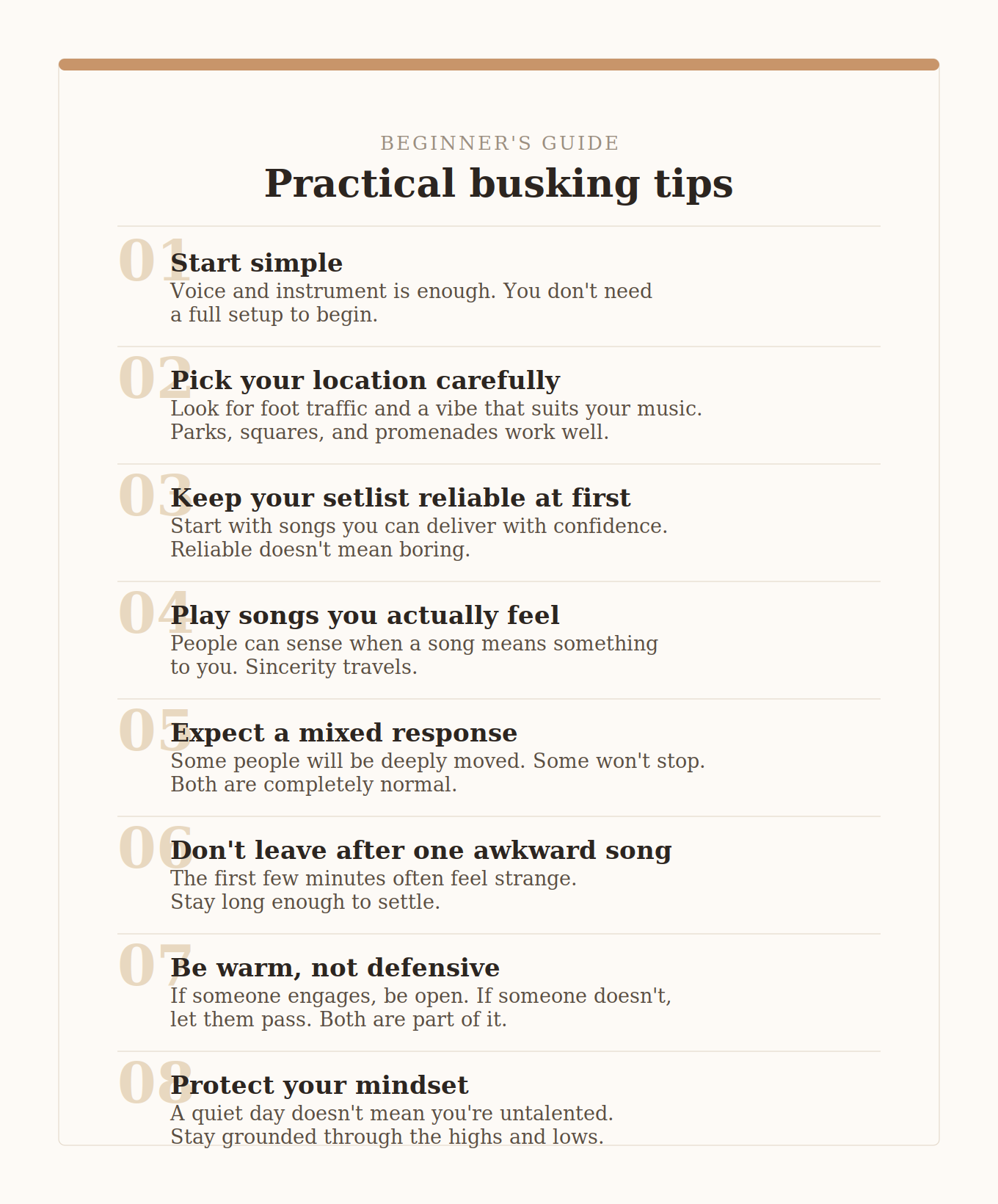
Practical Tips for Beginners
Start simple. Voice and instrument is enough.
Pick your location. Foot traffic helps, but so does finding a vibe that matches your music — parks, squares, promenades.
Keep your setlist reliable at first. Start with songs you can deliver with confidence.
Play songs you actually feel. People can tell when a song means something to you.
Expect a mixed response. Some people will be deeply moved. Some won't stop. Both are normal.
Don't leave after one awkward song. The first few minutes often feel strange. Stay long enough to settle.
Be warm, not defensive. If someone engages, be open. If someone doesn't, let them pass.
Protect your mindset. A quiet day doesn't mean you're untalented. A magical one doesn't mean hard days won't come. Stay grounded.
Why Busking Still Matters
In a world where music discovery is increasingly algorithmic, street performance is refreshingly human. It's unfiltered. It creates a moment instead of content. It asks for courage and gives back connection.
Watching James reminded me that music can still stop people in their tracks. It can still make strangers feel less alone. It can still turn a sidewalk or a random afternoon into something memorable.
For musicians, that's worth remembering.
Sometimes the next step in your growth isn't another hour hiding behind perfectionism at home. Sometimes it's stepping outside and singing anyway.